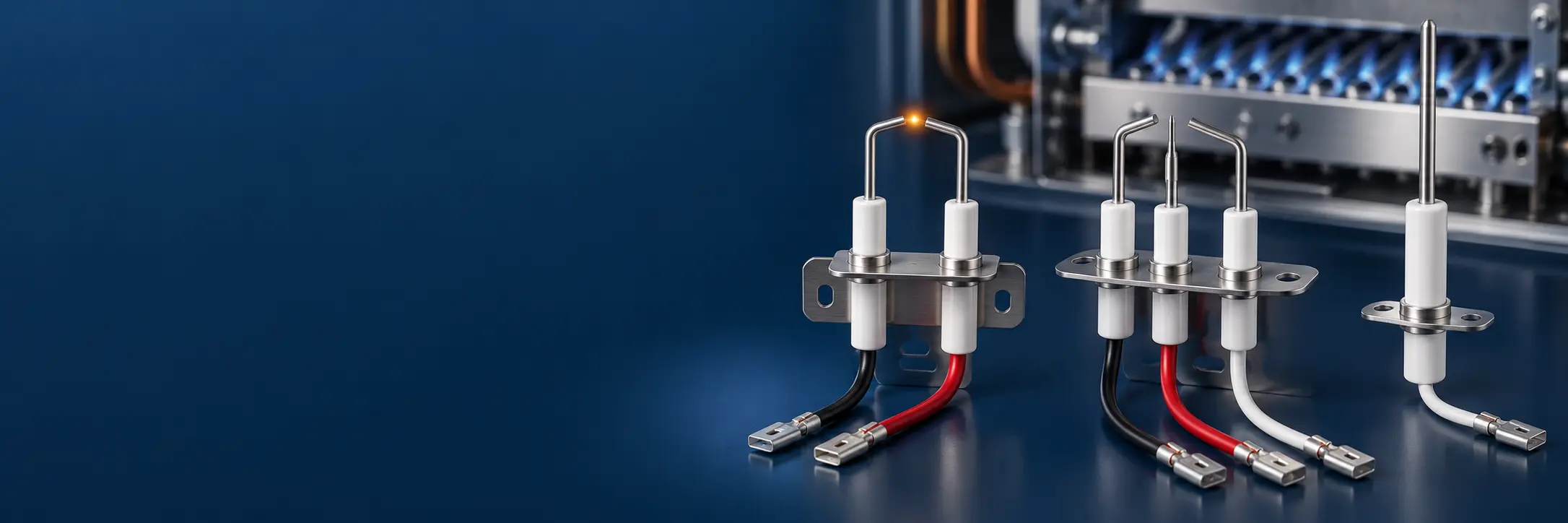
Products / Water Heater & Boiler
Water Heater & Boiler Ignition Electrodes & Flame Rods
Spark ignition electrodes, ionization flame rods and complete electrode sets for gas water heaters and wall-hung boilers, made to your drawing or sample.
Product List
Water Heater & Boiler Electrode Products
Open a product to see its full specifications, dimension drawing and options. Every part can be adjusted to your drawing.
Ignition and Flame Sensing in One Burner
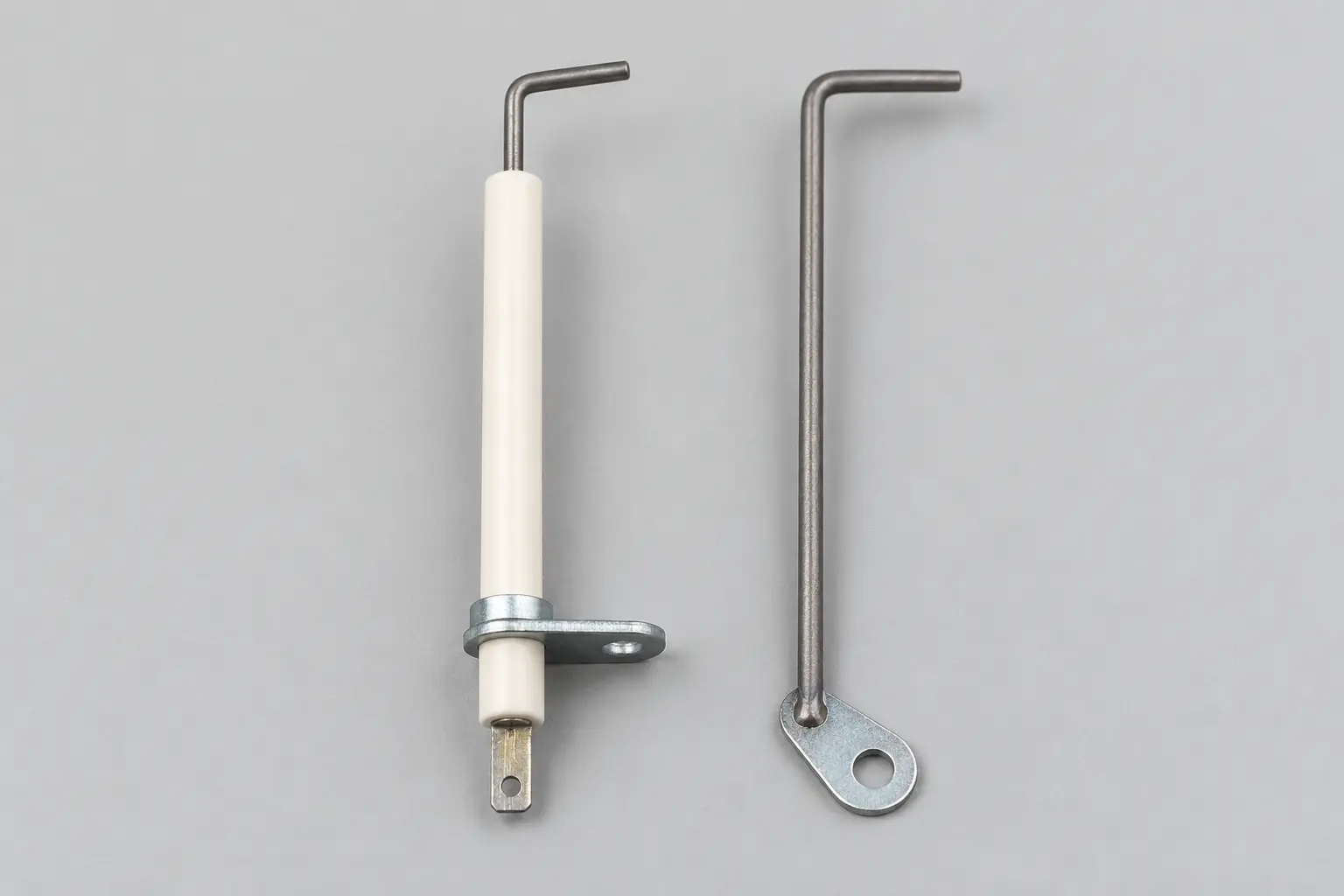
A gas boiler or water heater needs two things from its electrodes. A spark ignition electrode lights the burner, and a flame-sensing electrode, also called an ionization electrode or flame rod, tells the control board that the flame is really there. If the flame signal is lost, the board shuts off the gas.
Because these parts sit inside a hot combustion chamber and carry both high-voltage sparks and very small sensing currents, the quality of the ceramic matters. We make every boiler ignition electrode and flame rod from 95% alumina ceramic, with FeCrAl pins as standard and Kanthal® on request, and match the pin spacing, angles and bracket to your burner.
- Spark ignition electrodes, ionization rods and combined sets
- For combi boilers, system boilers and instantaneous or tankless water heaters
- Supplied as a matched replacement or designed into a new appliance
Electrode Types We Make
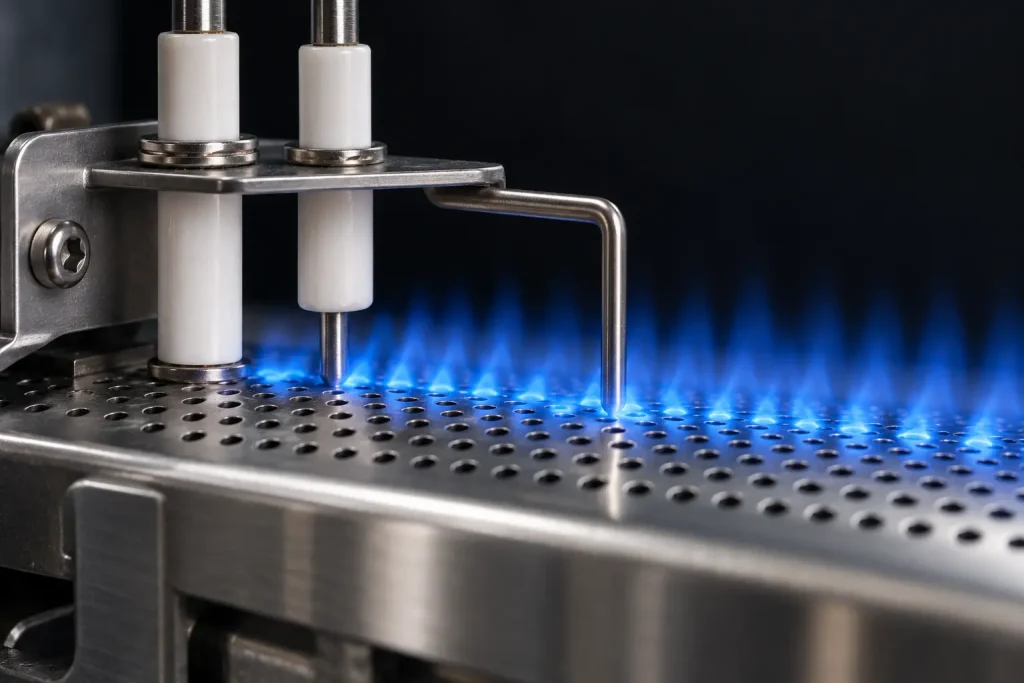
Water heater and boiler electrodes come in four basic designs. Send us a sample or photos and we will tell you which one you have.
Spark ignition electrodes
A single ceramic-insulated pin that sparks to the burner or to a ground pin, fixed with a bracket, flange or threaded sleeve.
Typical use: Water heaters and boilers with a separate flame sensor.
Ionization flame rods
A flame-sensing electrode that sits in the flame and carries a small current back to the control board to prove the flame.
Typical use: Boilers and water heaters that use flame rectification.
Combined ignition and ionisation sets
Two or three pins on one bracket: one or two for ignition and one for flame sensing, with fixed spacing and angles.
Typical use: Combi boilers and most modern wall-hung boilers.
Pilot burner electrodes
Compact electrodes that ignite and monitor a small pilot flame, which then lights the main burner.
Typical use: Storage water heaters and older boiler designs.
How a Flame Rod Works
The control board applies an AC voltage to the flame rod. A gas flame conducts a little electricity, and because the burner has a much larger surface than the rod, the current flows mainly in one direction. This is called flame rectification, and the board reads the resulting direct current, usually just a few microamps, as proof of flame.
That signal is tiny, so anything that leaks current or blocks it causes trouble: a cracked or dirty ceramic, a rod bent out of the flame, or a poor lead connection can all lead to lockouts. Good alumina ceramic and an accurate rod position keep the signal stable.
Common Causes of Lockouts
- Rod positioned outside the flame after a bend or knock
- Oxide or deposits on the rod surface
- Cracked ceramic allowing current leakage
- Loose or corroded lead connection
- Burner not properly grounded
When you send us a replacement order, we match the rod position to the original so the flame signal stays the same.
Specifications You Can Customize
| Component | Options for water heater and boiler electrodes |
|---|---|
| Ceramic insulator | 95% alumina (Al₂O₃) as standard; 98% alumina on request; length, diameter and profile to drawing |
| Electrode wire | FeCrAl heat-resistant alloy as standard; Kanthal® or other alloys on request; diameter, length, bend angle and tip shape to drawing |
| Mounting | Bracket, flange, or nut and thread (e.g. M8, M10, M12) |
| Lead wire | Silicone rubber, PTFE or fiberglass-braided high-temperature wire; length and color to order |
| Terminal | 2.8 mm, 4.8 mm or 6.3 mm female push-on, ring terminals, 4 mm plugs or customer-specified connectors |
| Configuration | Single-pin ignition, ignition with ground, flame-sensing (ionization) and multi-pin assemblies |
What We Match to Your Burner
- Spacing and angle between ignition and sensing pins
- Pin position relative to the burner surface
- Bracket shape and fixing-hole pattern
- Lead length to the control board or ignition transformer
- Terminal that fits your connector
Send a drawing, a used part or photos with a ruler, and we will prepare a matching drawing for your approval.
One Part, Many Names
The same parts are called by different names in different markets and by different engineers. Whatever you call them, we make them:
| Name | What it usually means |
|---|---|
| Boiler ignition electrode / boiler spark electrode | Spark electrode that lights a boiler burner |
| Water heater spark electrode | Spark electrode for a gas water heater |
| Ionisation electrode (UK) / ionization electrode (US) | Flame-sensing electrode |
| Flame rod / flame sensor electrode / flame sensing electrode | Flame-sensing electrode, common in North America |
| Flame rectification rod | Engineering term for a flame rod |
| Ignition and ionisation electrode / boiler electrode set | Combined multi-pin set on one bracket |
| Boiler spark plug | Common trade name in the Middle East and South Asia |
Water Heater & Boiler Electrode FAQ
What is the difference between an ignition electrode and an ionisation electrode?
The ignition electrode creates the spark that lights the burner. The ionisation electrode (flame rod) sits in the flame and sends a small current to the control board to confirm the flame is present. Many boilers mount both on one bracket.
Can one electrode do both ignition and flame sensing?
Yes. Some boilers use a single electrode for both jobs: it sparks to light the burner, then the control board switches it to flame sensing. We can make this type as well as separate pins and multi-pin sets.
Can you copy a complete electrode set, including the bracket?
Yes. Send us the used set or clear photos with a ruler. We reproduce the pin spacing, angles, bracket and lead, prepare a drawing for your confirmation and make free samples to match.
Do you make electrodes for tankless water heaters?
Yes. Instantaneous and tankless gas water heaters use the same types of spark and flame-sensing electrodes, and we make them to drawing or sample.
What is the minimum order?
Simple, low-cost electrodes usually start at 50,000 pieces per model, while multi-pin sets and more complex designs can be ordered in smaller quantities. See how we work for samples, tooling and order details.
Need a Boiler or Water Heater Electrode?
Send a drawing, a used part or photos with a ruler, and tell us the quantity. We will reply with a matching design and quotation.